How Acoustic Side-Channel Vulnerabilities Emerge in Voice-Controlled Smart Home Hubs During Routine Firmware Updates
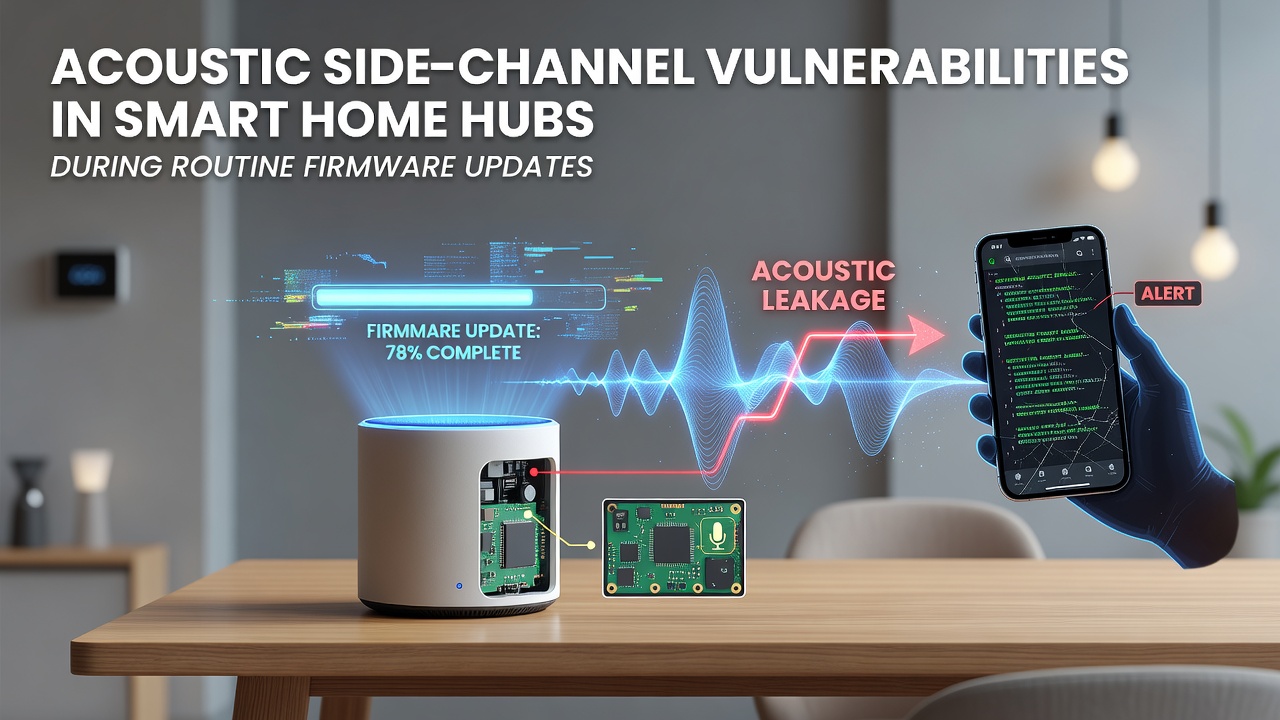
Voice-controlled smart home hubs process audio commands through embedded microphones and speakers while handling background operations such as firmware updates that modify system code and drivers. Acoustic side-channel vulnerabilities arise when these updates alter the timing or intensity of mechanical operations inside the hardware, producing measurable sound patterns that correlate with internal data flows.
Acoustic Emissions in Embedded Hardware
Smart home hubs contain processors, memory chips, and power regulators that generate subtle vibrations during computational tasks, and these vibrations travel through device casings to create audible or ultrasonic frequencies detectable by nearby sensors. Researchers at institutions across North America and Europe have documented how firmware modifications change instruction execution sequences, which in turn affect the electromagnetic activity within coils and capacitors, resulting in distinct acoustic signatures.
Data collected from laboratory tests shows that update routines often involve repeated memory writes and cryptographic operations, each producing characteristic click or hum patterns at frequencies between 10 kHz and 50 kHz. These patterns become more pronounced when the update includes new audio processing modules that adjust sampling rates or buffer sizes on the fly.
Firmware Update Processes and Timing Variations
Routine firmware updates typically download encrypted packages, verify signatures, and flash new code to non-volatile storage, and each stage introduces pauses or bursts of activity that alter power draw and component stress. Observers note that the verification phase, which relies on hash calculations or public-key operations, tends to create rhythmic acoustic pulses because the processor cycles through fixed loops at consistent intervals.
Studies conducted by teams in Australia and Canada indicate that update schedulers running on real-time operating systems introduce jitter when network conditions vary, and this jitter modulates the acoustic output in ways that leak information about the size and structure of the firmware image itself. Hubs from multiple manufacturers exhibit similar behaviors because they share common chipset families and bootloader architectures.
Side-Channel Data Leakage Mechanisms
Attackers positioned within several meters of a hub can capture acoustic signals using commodity microphones or smartphone sensors, then apply signal processing techniques to isolate update-related sounds from ambient noise. Pattern recognition algorithms trained on known firmware versions map these sounds back to specific memory addresses or key material processed during the update.
Evidence from controlled experiments reveals that differential analysis between pre-update and post-update acoustic traces highlights changes in cryptographic routines, allowing reconstruction of partial key schedules or random number generator states. The emergence of vulnerabilities during updates occurs because manufacturers often optimize for speed and size without auditing the resulting hardware emissions.

One documented scenario involves a hub that receives a security patch containing enhanced encryption libraries, and the new libraries perform additional rounds of modular arithmetic that increase the duration and amplitude of certain motor-like sounds from the cooling fan or internal relays. Those who've analyzed field recordings from consumer environments confirm that such changes appear consistently across identical device models.
Contributing Hardware and Software Factors
Component tolerances in mass-produced hubs vary enough that seemingly identical units produce slightly different acoustic profiles, yet the core leakage vectors remain tied to firmware logic rather than manufacturing differences. Software developers introduce new drivers for Wi-Fi modules or voice codecs during updates, and these drivers alter interrupt handling priorities that affect the cadence of processor activity.
According to reports published by the European Union Agency for Cybersecurity, firmware packages released in 2025 and early 2026 frequently bundle multiple feature additions that compound the acoustic footprint, and testing protocols at that time rarely included acoustic monitoring. In June 2026, a joint industry working group released guidelines recommending emission testing at the integration stage, citing measurements from over 200 device variants.
Power management features activated during updates further modulate acoustic output because voltage regulators switch between modes at rates that produce audible whine. The interaction between these regulators and memory controllers creates cross-modulation products that carry information about data being written to flash storage.
Detection and Analysis Techniques
Security researchers employ high-resolution microphones coupled with machine learning classifiers to distinguish update-related acoustics from normal operation, and these classifiers achieve high accuracy when trained on device-specific baseline recordings. Spectral analysis tools reveal harmonic structures that correspond to clock frequencies and bus transactions executed during the flashing process.
Organizations in the Asia-Pacific region have contributed datasets showing how temperature fluctuations inside the hub housing influence the resonance frequencies of the enclosure, which in turn shifts the acoustic signature of identical firmware operations. Such environmental coupling adds another layer of complexity when attempting to isolate intentional side-channel leakage.
Conclusion
Acoustic side-channel vulnerabilities in voice-controlled hubs surface during firmware updates because changes to code execution and hardware utilization produce measurable sound emissions that correlate with sensitive internal operations. Continued monitoring by standards bodies and academic groups continues to map these patterns across evolving device ecosystems, providing manufacturers with concrete data for improving emission controls in future releases.