On-Device Neural Accelerators Enable Livestock Health Monitoring Through Decentralized Pasture Networks
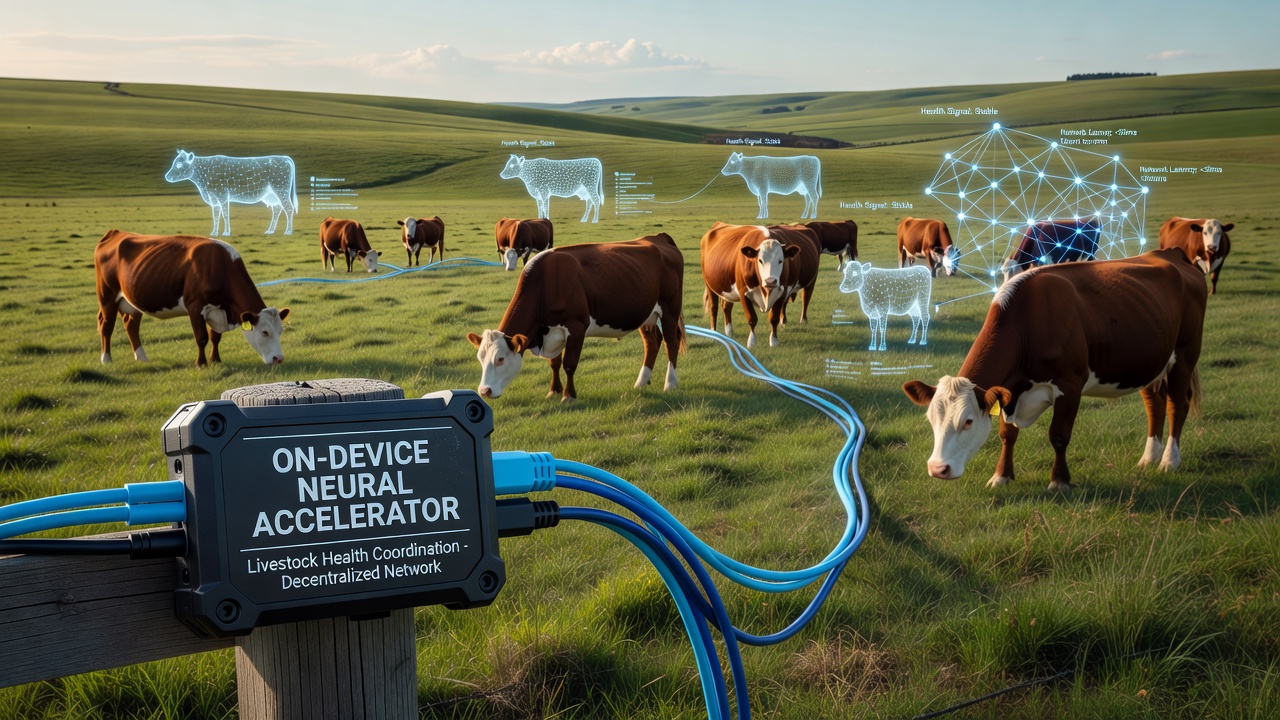
Researchers have developed systems where on-device neural accelerators analyze livestock vital signs directly at the sensor level, then share processed insights across mesh networks spanning remote pastures. These setups operate without reliance on central servers, allowing continuous coordination even when connectivity drops for extended periods. Data from accelerometers, temperature probes, and heart rate monitors flows through low-power wireless protocols that link individual animal collars into self-organizing clusters.
How Local Processing Replaces Centralized Infrastructure
Each collar contains a neural accelerator chip that runs lightweight models trained to detect anomalies such as elevated body temperature or irregular movement patterns. Instead of transmitting raw sensor streams, the devices classify events locally and broadcast only compact alerts or aggregated statistics to neighboring nodes. This approach reduces bandwidth demands dramatically while preserving battery life across weeks of operation in open rangeland. Observers note that mesh routing protocols automatically reroute messages around obstacles like hills or dense tree lines, maintaining network integrity without any fixed base station.
Studies conducted in Australian grazing regions demonstrate that such networks sustain operation across areas exceeding 500 square kilometers. Nodes exchange model updates through periodic peer-to-peer handshakes, allowing the collective system to refine detection thresholds based on shared observations while each accelerator continues independent inference. According to reports from the Commonwealth Scientific and Industrial Research Organisation, these techniques have supported real-time tracking of cattle herds during seasonal migrations where traditional cellular coverage remains unavailable.
Coordination Mechanisms Across Distributed Nodes
Communication relies on protocols such as LoRa and Bluetooth Low Energy variants optimized for multi-hop transmission. When one device identifies a potential health concern, it propagates a tokenized summary to adjacent collars, which then cross-reference the signal against their own readings. Consensus emerges through simple voting mechanisms embedded in the accelerator firmware, triggering notifications only when multiple nodes confirm the pattern. This distributed validation step minimizes false positives that would otherwise overwhelm limited transmission windows.
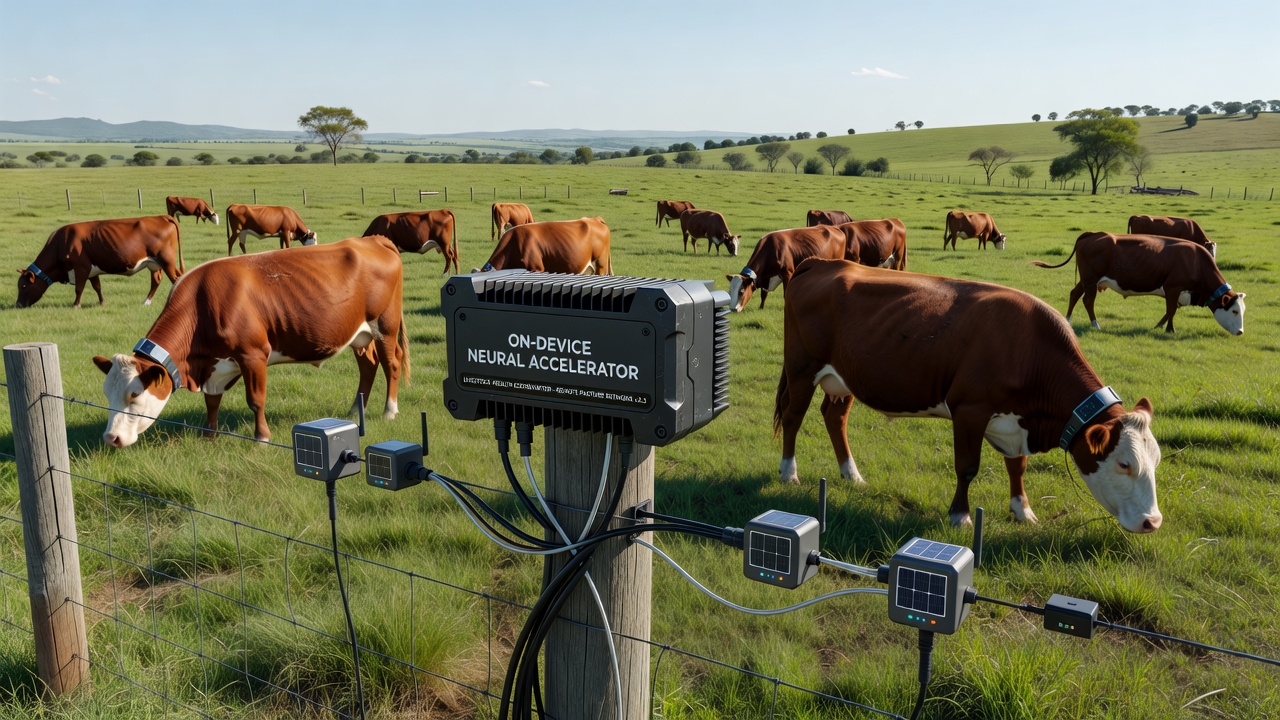
By June 2026, pilot programs in Canadian prairie provinces had integrated similar accelerators with solar-powered repeater posts placed at natural water points, extending effective range without introducing server dependencies. The repeaters function purely as signal amplifiers, performing no data aggregation or storage themselves. European research consortia have explored parallel approaches using ultra-wideband pulses for finer location tracking within the same decentralized framework.
Applications in Remote and Variable Environments
Farmers managing extensive properties in arid zones report that localized neural processing allows earlier intervention during heat stress events because alerts reach nearby personnel through handheld receivers rather than requiring backhaul to distant data centers. The same architecture supports tracking of lambing or calving activity by recognizing behavioral signatures unique to each species. Because models reside entirely on the accelerators, system operators can update firmware across the network through over-the-air patches delivered node-to-node, avoiding any requirement for cloud synchronization.
One documented deployment in New Zealand high-country stations showed that herds instrumented with these collars maintained 98 percent uptime during multi-day storms that severed all external internet links. The network continued exchanging health summaries internally, storing critical events in distributed buffers until connectivity resumed. Such resilience proves particularly valuable in regions where weather patterns frequently isolate livestock operations for days at a time.
Technical Considerations and Scaling Factors
Power budgets dictate that accelerators operate at milliwatt levels, favoring quantized neural networks with eight-bit weights and activations. Training occurs offline on larger systems before deployment, after which the pasture network handles only incremental adaptation through federated-style averaging among neighboring devices. Security relies on hardware-rooted encryption keys burned into each accelerator during manufacture, ensuring that intercepted messages reveal neither raw physiological data nor model parameters.
Hardware manufacturers have begun embedding these accelerators into standard livestock ear tags, reducing per-animal costs below traditional GPS collars. Compatibility testing across multiple breeds confirms that form factors accommodate both cattle and smaller ruminants without altering established husbandry practices. Data from these systems feeds directly into existing farm management software through periodic gateway uploads when vehicles or drones pass within range, completing the loop without persistent central infrastructure.
Conclusion
On-device neural accelerators paired with pasture-scale mesh networks demonstrate a practical pathway for continuous livestock health monitoring in areas lacking reliable infrastructure. The technology processes signals locally, coordinates insights through peer communication, and maintains functionality independent of external servers. Deployments through mid-2026 illustrate measurable improvements in response times and operational continuity across diverse geographic settings.