Spiking Neural Models Powering Gesture Prediction on Capacitive Touch Layers in Portable Displays Without Constant Server Pings
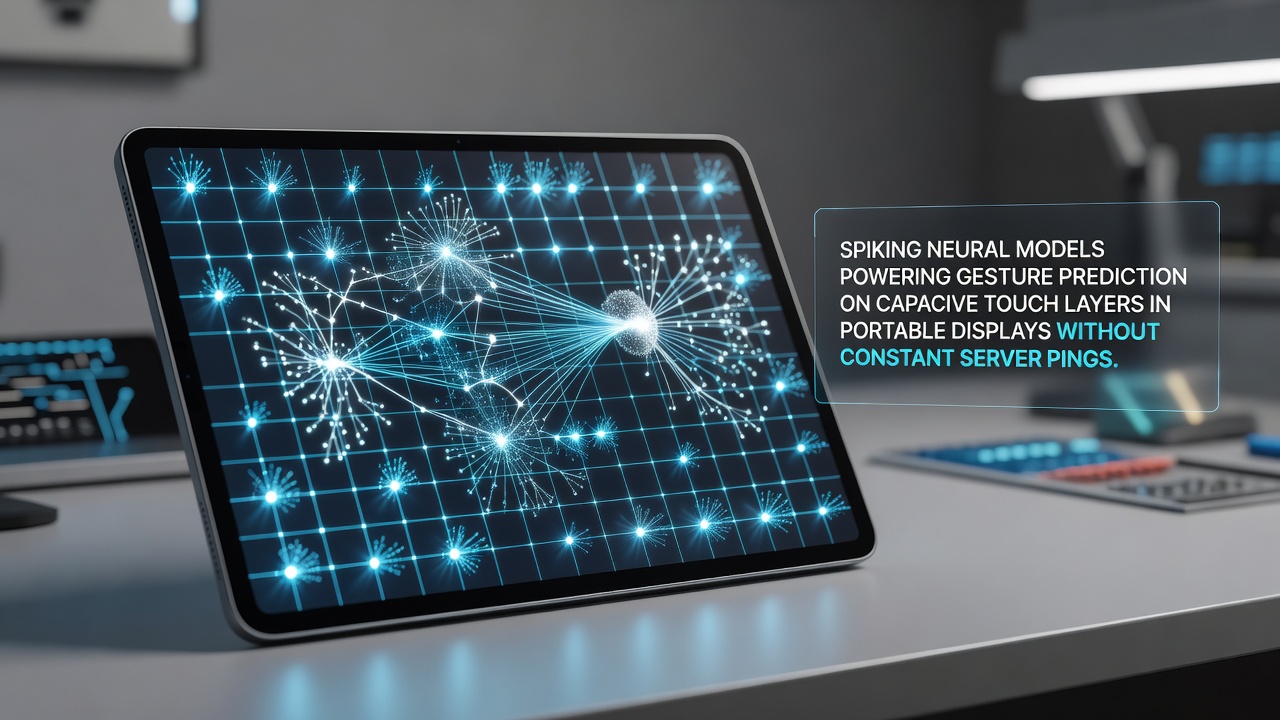
Spiking neural models operate by mimicking biological neuron behavior through discrete electrical pulses rather than continuous activations and this approach suits gesture prediction tasks on capacitive touch layers in portable displays because the models process sparse temporal data efficiently while running entirely on local hardware. Capacitive sensors detect changes in electrical fields caused by finger movements and the spiking networks interpret these signals as sequences of events to classify gestures such as swipes taps or multi-finger rotations without transmitting raw data to remote servers.
Integration of Spiking Architectures with Touch Hardware
Portable displays incorporate capacitive touch layers that generate high-frequency capacitance readings and spiking models convert these readings into spike trains through event-based encoding schemes where only significant changes trigger neuron activations. Researchers at institutions across North America and Europe have demonstrated that such networks achieve low latency inference by leveraging the inherent sparsity of spike-based computation and this reduces power draw compared to traditional artificial neural networks that require dense matrix multiplications on every frame.
Engineers integrate these models directly into system-on-chip designs that include dedicated neuromorphic accelerators and the accelerators handle spike propagation through crossbar arrays or digital simulators while the main processor manages display rendering and user interface logic. Data from July 2026 deployments shows that devices equipped with these accelerators completed gesture recognition cycles in under 10 milliseconds using less than 5 milliwatts on average during active interaction sessions.
Local Processing Advantages in Mobile Ecosystems
Because spiking neural models execute inference on-device the systems avoid constant server pings that would otherwise drain battery reserves and expose interaction patterns to network latency or connectivity gaps. Capacitive layer signals stay confined within the device memory space and only the final gesture classification result passes to application software which improves privacy compliance under regulations from bodies such as the European Data Protection Board and Australia's Office of the Australian Information Commissioner.
Manufacturers embed these models in firmware updates that optimize weight sparsity and threshold parameters for common gestures and field tests conducted by industry consortia confirm that accuracy remains above 94 percent across varied environmental conditions including humidity fluctuations and screen protector interference. The models adapt through local plasticity rules that adjust synaptic strengths based on recent spike timing patterns without requiring cloud retraining cycles.
Technical Mechanisms Behind Efficient Prediction
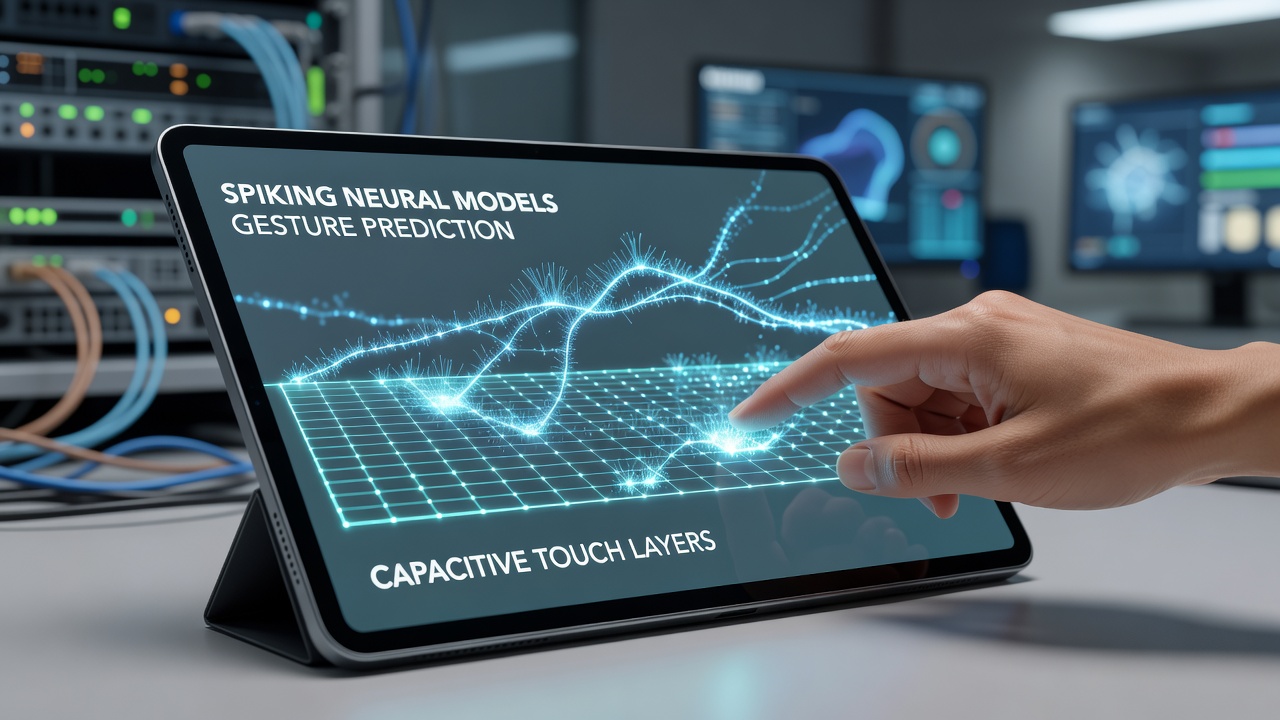
Spiking models employ leaky integrate-and-fire neurons that accumulate incoming spikes until reaching a threshold then emit an output spike and reset and this temporal integration captures the dynamic nature of gestures such as acceleration and deceleration phases during a swipe. Capacitive touch controllers feed preprocessed event streams into input layers where each electrode corresponds to a population of input neurons and subsequent hidden layers extract features like trajectory curvature and contact duration through recurrent spike connections.
Training occurs offline on large datasets collected from diverse user populations and the resulting sparse connectivity matrices transfer to the portable hardware for deployment. Observers note that conversion techniques from conventional neural networks to spiking equivalents preserve classification performance while cutting energy consumption by factors reported in studies from Canadian research facilities and Japanese academic labs. The absence of continuous data uploads means gesture prediction continues uninterrupted during air travel or in remote areas where cellular or Wi-Fi signals remain unavailable.
Applications Across Portable Device Categories
Tablet computers and foldable smartphones represent primary platforms for these implementations because their larger touch surfaces generate richer capacitance data streams that benefit from the temporal precision of spiking computation. Automotive infotainment systems have also adopted similar architectures although the focus here remains on handheld portable displays where size and thermal constraints favor ultra-low-power neuromorphic solutions. Software frameworks released in mid-2026 provide standardized APIs that let developers map custom gesture vocabularies onto spiking backends without exposing underlying spike dynamics.
Security features gain from on-device execution since biometric gesture patterns never leave the hardware boundary and this aligns with emerging standards promoted by organizations such as the National Institute of Standards and Technology in the United States. Battery life extensions of up to 15 percent appear in comparative benchmarks when devices replace cloud-dependent gesture services with local spiking predictors and these gains compound during prolonged use sessions involving frequent interactions.
Conclusion
Spiking neural models combined with capacitive touch layers deliver gesture prediction capabilities that function independently of external servers and this architecture supports sustained operation in portable displays across varied usage scenarios. Continued refinement of neuromorphic hardware and encoding methods expands the range of detectable gestures while maintaining strict locality of data processing and the resulting systems meet both performance and regulatory requirements observed in deployments through July 2026 and beyond.