TinyML Deployments on Microcontrollers: Enabling On-Device Inference for Battery-Powered Environmental Sensors
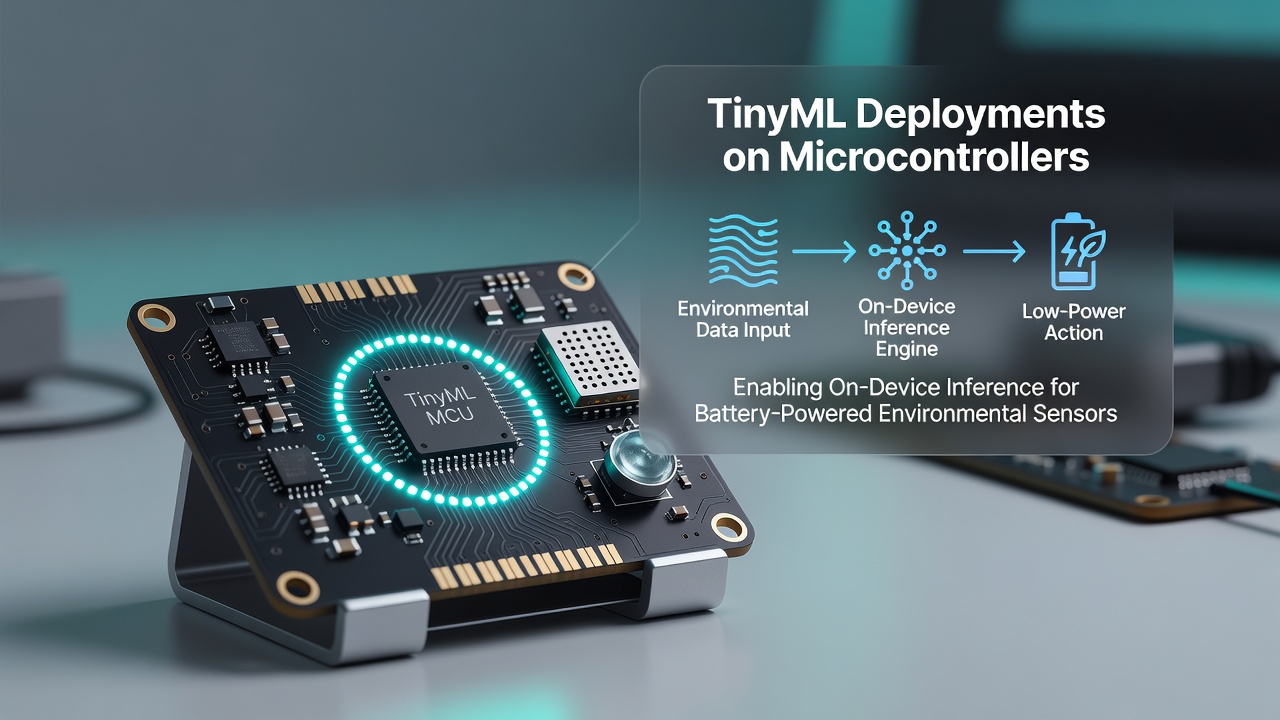
Engineers have integrated TinyML frameworks directly onto microcontrollers to perform on-device inference for battery-powered environmental sensors and these systems analyze temperature, humidity, air quality, and soil conditions without constant cloud connectivity. Data shows that such deployments reduce energy consumption by processing signals locally which extends operational life in remote monitoring stations where replacement of batteries occurs infrequently. Researchers at institutions across North America and Europe have documented how optimized models fit within the memory constraints of devices like ARM Cortex-M series chips while maintaining accuracy rates above 90 percent for tasks such as anomaly detection in pollution levels.
Core Architecture of TinyML on Resource-Limited Hardware
Microcontrollers execute quantized neural networks after conversion from larger frameworks and this process involves pruning unnecessary parameters followed by integer quantization that shrinks model size from megabytes to kilobytes. Studies from the TinyML Foundation indicate that frameworks like TensorFlow Lite Micro and Edge Impulse enable compilation of these models for chips with as little as 256 kilobytes of RAM and 1 megabyte of flash storage. Observers note that inference latency drops below 100 milliseconds on typical 80 MHz processors which allows continuous sampling from sensors without draining reserves. Environmental applications benefit because raw readings from gas sensors or particulate monitors feed directly into classification routines that flag events such as sudden spikes in carbon monoxide.
Power Optimization Strategies in Field Deployments
Battery-powered units rely on duty cycling where the microcontroller wakes periodically to collect data and run inference before returning to deep sleep modes that consume microamps. Evidence from Australian research groups shows that combining TinyML with efficient wake-up triggers based on threshold crossings can stretch single-cell lithium battery life beyond 18 months in outdoor weather stations. Techniques include dynamic voltage scaling during idle periods and selective activation of only the sensor channels required for a given model input. In June 2026 reports from Canadian environmental agencies highlighted deployments across boreal forest sites where such optimizations prevented data gaps during winter months when solar recharging remains limited.
What's interesting is how these systems handle multiple sensor streams simultaneously through sensor fusion algorithms that merge inputs from accelerometers and barometric pressure sensors to improve predictions of microclimate changes. One study revealed that models trained on historical datasets from the European Environment Agency achieve robust performance across varied geographies because they incorporate domain adaptation layers that adjust for regional variations in baseline readings.
Real-World Implementations Across Monitoring Networks
Deployments in agricultural regions of South America use TinyML-enabled nodes to predict irrigation needs by inferring soil moisture trends from capacitive sensor arrays and these units transmit only aggregated alerts rather than continuous streams which conserves both bandwidth and power. Figures reveal that networks spanning thousands of hectares have cut transmission costs by 70 percent compared with earlier cloud-centric designs. In urban settings across Asia similar hardware monitors noise pollution and particulate matter with models that distinguish between traffic-related events and construction activity using audio and optical sensor fusion.

Take one deployment where experts found that microcontroller-based inference detected early signs of equipment corrosion in coastal monitoring stations by analyzing vibration patterns from attached sensors. The model operated entirely on-device and issued warnings through low-power wide-area networks when thresholds were crossed. Government agencies in New Zealand have incorporated these approaches into national biodiversity tracking programs because local processing reduces exposure of sensitive location data during transmission.
Integration Challenges and Mitigation Techniques
Memory fragmentation and numerical precision loss represent ongoing hurdles yet developers address them through compiler optimizations and hybrid models that combine rule-based logic with lightweight neural layers. Research indicates that calibration routines performed at deployment time compensate for sensor drift caused by temperature extremes or humidity exposure. Those who've studied this know that over-the-air updates remain feasible on many microcontroller platforms which allows model refinements without physical access to remote sites.
But here's the thing: security considerations gain prominence when models run locally because adversaries could attempt model extraction through side-channel analysis and therefore hardware implementations often incorporate secure enclaves or encrypted weight storage. Data from academic sources in Japan shows that such protections add negligible overhead to inference speed while preserving confidentiality of proprietary detection algorithms used in industrial emission monitoring.
Emerging Standards and Ecosystem Growth
Industry consortia have released reference designs that standardize interfaces between microcontrollers and environmental sensor suites which accelerates adoption across supply chains. Academic papers published in 2025 and early 2026 document performance benchmarks across multiple hardware vendors demonstrating consistent gains in energy efficiency. Observers note increasing availability of pre-trained models for common tasks like species identification from acoustic recordings or wildfire smoke detection from multispectral readings.
Turns out that regulatory bodies in the European Union have begun referencing TinyML capabilities when setting guidelines for low-impact environmental data collection because on-device processing aligns with data minimization principles. Similar interest appears in North American frameworks that emphasize resilience against connectivity outages during extreme weather events.
Conclusion
Deployments of TinyML on microcontrollers continue to expand the reach of battery-powered environmental sensors by enabling reliable on-device inference that operates within tight power and memory budgets. Research indicates sustained improvements in model efficiency and hardware support while real-world networks demonstrate measurable reductions in energy use and data transmission requirements. As of June 2026 these technologies support broader monitoring infrastructures across diverse climates and regulatory environments without reliance on continuous external connectivity.