Vibration-Powered Nodes Track Wildlife Migrations Across Protected Areas

Researchers have developed sensor networks that draw power directly from mechanical vibrations generated by wind, footfalls, and terrain shifts, allowing continuous operation across remote conservation zones without scheduled battery changes or external charging infrastructure.
These nodes integrate piezoelectric materials that convert kinetic energy into electrical current, feeding low-power microcontrollers and wireless transmitters designed for intermittent data bursts rather than constant streams. Studies from energy-harvesting labs show that even subtle ground tremors from migrating herds can sustain transmission cycles lasting several seconds every few minutes, sufficient for location and environmental telemetry.
Energy Harvesting Mechanics in Field Conditions
Piezoelectric cantilevers inside each node flex under repeated stress, producing micro-watts that accumulate in supercapacitors rated for thousands of charge-discharge cycles. Observers note that this approach eliminates the weight and volume penalties of traditional lithium cells, letting units weigh under 150 grams while surviving temperature swings from sub-zero nights to daytime highs above 40 degrees Celsius.
Data loggers record vibration amplitude alongside GPS fixes and temperature readings, then compress packets for relay through mesh topologies that extend range without increasing individual node power draw. Figures from field trials indicate average daily energy yields of 200 to 800 microwatt-hours in typical grassland and forest edge environments, enough to support multi-year deployments before any maintenance visit becomes necessary.
Deployment Patterns in Large-Scale Reserves
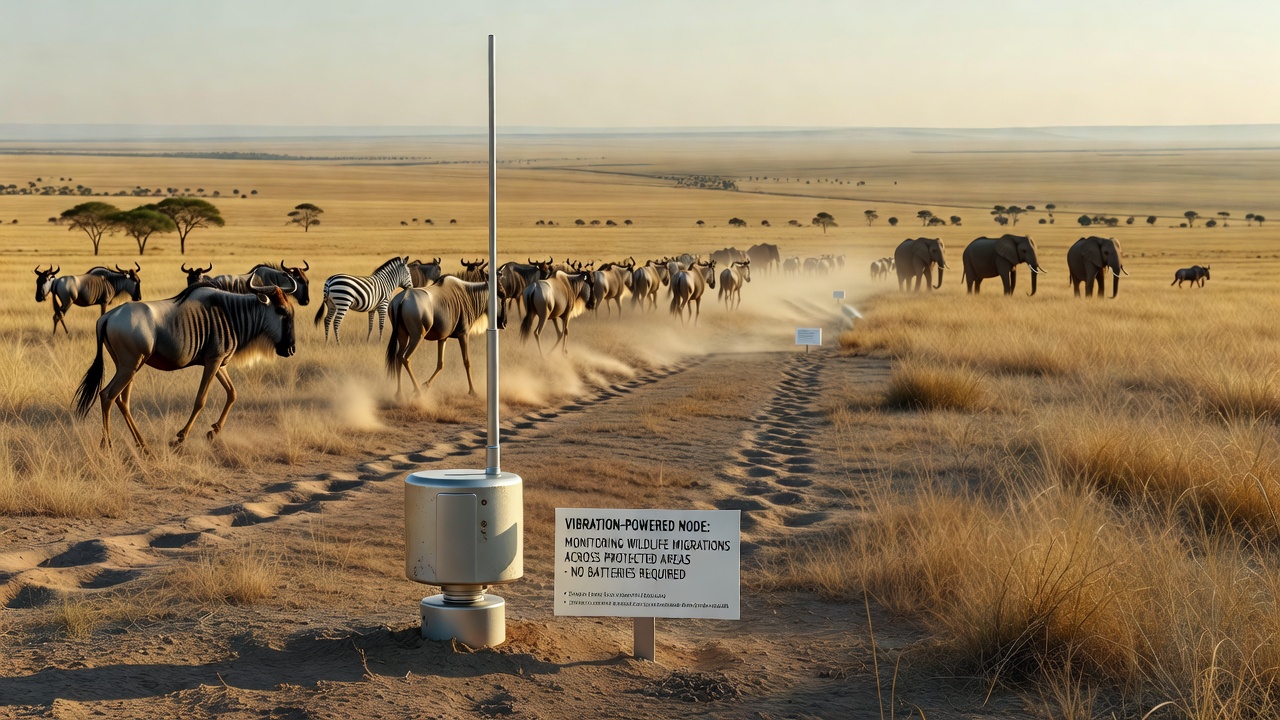
Conservation teams place nodes along known migration corridors at intervals of 500 to 2000 meters, anchoring them to trees, rocks, or buried stakes to maximize contact with vibrational sources. In July 2026, a coordinated rollout across two African reserves and one North American park began collecting synchronized movement data on species including wildebeest, caribou, and elephant populations.
Each node registers passage events by detecting characteristic vibration signatures, then forwards time-stamped coordinates to gateway stations powered by small solar panels or additional vibration harvesters. This architecture creates overlapping coverage zones that capture both linear migrations and seasonal detours caused by drought or human activity.
Data Integration and Analysis Pipelines
Raw telemetry streams feed into centralized databases where machine-learning models distinguish species-specific gait patterns from background noise such as wind gusts or falling branches. Analysts cross-reference node detections with satellite imagery and collar data from a smaller subset of tagged animals, producing migration density maps updated daily.
According to reports published by the US Geological Survey Northern Prairie Wildlife Research Center, vibration-node networks have achieved detection rates above 85 percent for large-bodied migrants when calibrated against visual counts during peak movement periods. The same datasets reveal timing shifts of up to three weeks in spring arrivals compared with records collected two decades earlier.
Comparative Advantages Over Battery-Dependent Systems
Traditional collar or tag programs require recapture or replacement every 12 to 36 months, incurring helicopter or ground-team costs that scale with area size. Vibration-powered alternatives reduce these interventions to visual inspections and occasional firmware updates transmitted over the air. Cost models developed by Australian research groups estimate lifetime ownership expenses drop by 40 to 60 percent once initial installation is complete.
Yet the approach carries trade-offs: energy availability fluctuates with weather and animal density, so nodes incorporate duty-cycling algorithms that throttle transmission when harvests fall below thresholds. Redundant mesh paths compensate for temporary outages, maintaining overall network resilience documented in multi-year test beds across arid and temperate biomes.
Regulatory and Ethical Considerations
Protected-area authorities require that equipment leave minimal physical traces and avoid altering animal behavior. Nodes constructed from biodegradable housings and non-toxic adhesives now satisfy guidelines issued by the International Union for Conservation of Nature technical working groups on monitoring technology. Electromagnetic emissions remain below thresholds that could interfere with native species navigation cues.
Privacy frameworks also apply when data includes incidental recordings of human activity near reserve boundaries. Aggregation protocols strip identifying metadata before long-term storage, aligning with data-protection standards adopted by multiple national wildlife agencies.
Conclusion
Vibration-powered nodes supply a maintenance-light platform for continuous migration surveillance across expansive reserves where battery logistics have historically constrained coverage. Continued refinement of energy-conversion efficiency and mesh reliability will determine how widely these systems expand into additional continents and taxa during the coming decade.