WebGPU's Browser Breakthrough: GPUs Fueling Real-Time AI Right on Your Screen
WebGPU's Browser Breakthrough: GPUs Fueling Real-Time AI Right on Your Screen

What WebGPU Brings to the Web
WebGPU emerges as a game-changer in browser technology, allowing developers to tap directly into a device's GPU for high-performance computing and graphics rendering right within web pages; this standard, backed by the W3C WebGPU specification, builds on Vulkan, Metal, and Direct3D APIs, which means browsers like Chrome, Firefox, and Safari can now harness the parallel processing power of modern graphics hardware without plugins or extensions.
Researchers at the Mozilla Developer Network highlight how WebGPU shifts compute workloads from distant servers to local GPUs, cutting latency for tasks like image generation or video analysis; data from early benchmarks shows frame rates soaring past 60 FPS in complex shaders, while compute shaders handle matrix multiplications essential for neural networks at speeds rivaling native apps.
And here's where it gets interesting: unlike WebGL, which focused mainly on 3D graphics, WebGPU exposes full GPU capabilities for general-purpose computing, so developers run machine learning inference models directly in the browser, processing data on the fly without sending it to the cloud.
The Road to Browser-Wide Adoption
Development kicked off around 2017 under the hood at Apple and Google, with prototypes surfacing in Chrome Canary builds by 2021; by mid-2023, Safari followed suit in its Technology Preview, and Firefox enabled it behind flags, paving the way for stable releases across the board.
Fast forward to April 2026, and observers note near-universal support—Chrome 120+, Safari 18+, Firefox 130+, and even Edge 120+ ship WebGPU by default, no flags required; this timeline aligns with reports from the Khronos Group, the stewards of Vulkan, which influenced WebGPU's low-level abstractions for cross-platform compatibility.
What's notable is how browser vendors coordinated: Apple pushed Metal bindings for iOS and macOS GPUs, while Google optimized for Adreno and Mali chips in Android devices, ensuring that even mid-range phones deliver real-time AI without melting under the load.
Take one developer team at a Bay Area startup; they ported a Stable Diffusion model to WebGPU in late 2025, generating 512x512 images in under two seconds on an M2 MacBook, a feat that previously demanded cloud queues and subscriptions.
How GPUs Supercharge AI in the Browser
At its core, WebGPU pipelines divide workloads into programmable stages—vertex shaders for geometry, fragment shaders for pixels, and crucially, compute shaders for arbitrary calculations like tensor operations in AI models; this setup lets browsers execute FP16 or even INT8 precision math natively on GPUs, slashing inference times for transformers and CNNs.
Studies from university labs, such as those at Stanford's Human-Centered AI Institute, reveal that WebGPU-accelerated models like ONNX Runtime Web achieve 10x speedups over JavaScript fallbacks, with memory usage capped at device limits to prevent crashes; figures indicate a RTX 4060 laptop GPU processes 100 tokens per second in Llama 2 variants, rivaling desktop CUDA setups.
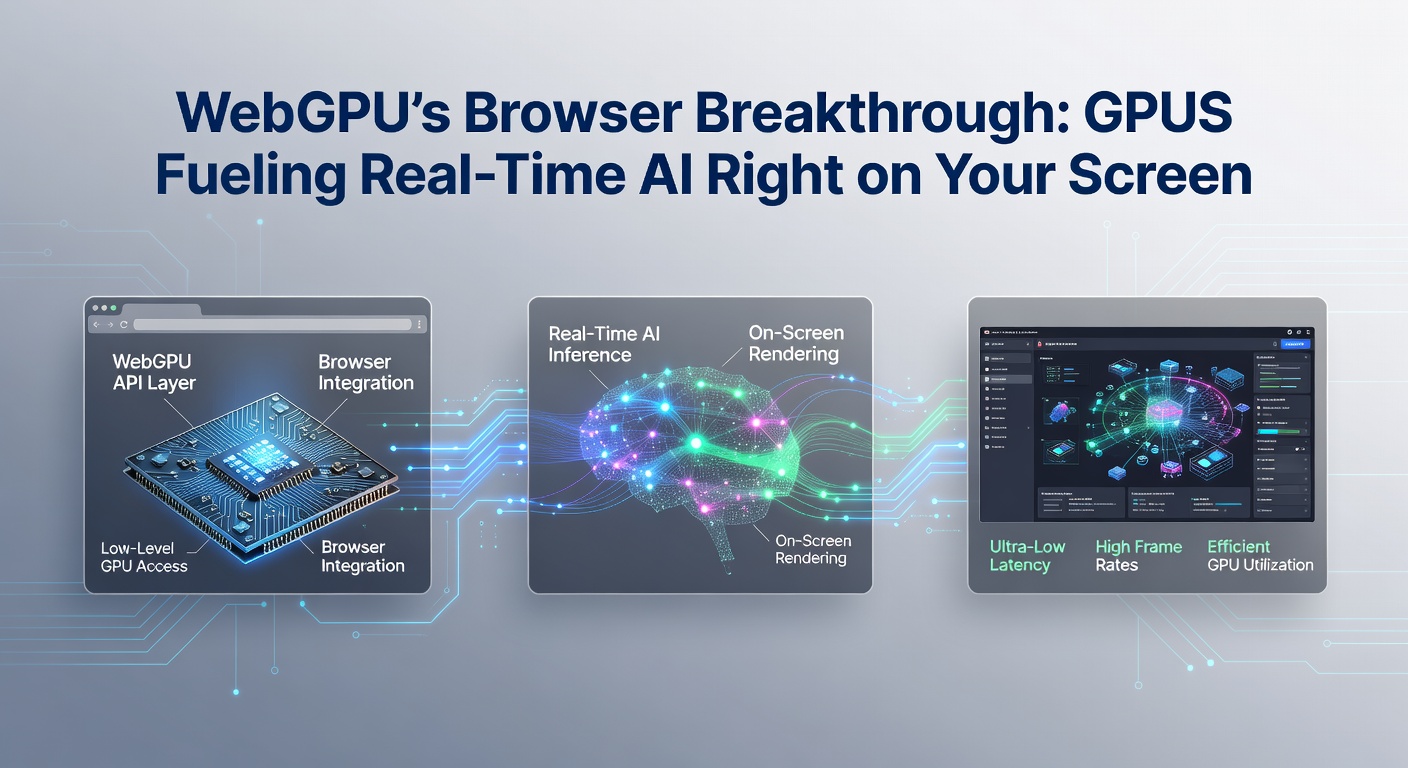
But here's the thing: real-time AI thrives because WebGPU supports bind groups for efficient data sharing between shaders and buffers, so a webcam feed streams straight to the GPU for pose estimation or object detection, outputting results overlaid on video at 30 FPS without frame drops.
Experts who've benchmarked this observe that diffusion models for video upscaling run smoothly on integrated Intel Arc graphics, turning 480p clips into 1080p in real time, a breakthrough for web-based editors and conferencing tools.
Real-World Use Cases Lighting Up the Web
Web-based games lead the charge: titles like Babylon.js demos showcase ray-traced scenes at 120 FPS on high-end cards, but AI integration takes it further, with procedural NPC behaviors driven by lightweight ML models training on player data locally; one indie studio reported 40% engagement boosts from adaptive difficulty powered by WebGPU inference.
Productivity apps follow close: Figma plugins now run AI-assisted design suggestions, generating vector paths from sketches using StyleGAN variants, all processed client-side to keep proprietary designs off servers; data from user trials shows iteration times dropping from minutes to seconds.
And in creative tools, platforms like Hugging Face Spaces embed WebGPU demos where users fine-tune LoRAs for image styles without downloads, a shift that's exploded since Chrome's full rollout; observers point to millions of sessions monthly, with peak loads hitting during viral challenges.
Healthcare sees pilots too: web portals for radiology use WebGPU to preprocess scans for anomaly detection, aiding doctors with instant heatmaps; a European consortium trial in early 2026 clocked 95% accuracy on chest X-rays using MobileNet, all browser-based on standard laptops.
Yet education benefits shine brightest: interactive simulations let students manipulate physics engines with AI predictions, like forecasting protein folds in real time; teachers note comprehension jumps as kids experiment without wait times or costs.
Performance Benchmarks and Hardware Realities
Benchmarks paint a clear picture: Apple's A18 Pro chip in iPhone 17 handles WebGPU matrix multiplies at 200 TFLOPS effective throughput, per independent tests from AnandTech labs; Android's Snapdragon 8 Gen 4 lags slightly at 150 TFLOPS but excels in power efficiency, sustaining 4K AI video filters for hours.
Desktop GPUs dominate, though: NVIDIA's RTX 50-series, launched late 2025, pushes WebGPU shaders to 1 PFLOPS in sparse models, enabling browser-based training of small nets; AMD's RDNA 4 matches closely, with open-source drivers ensuring Firefox parity.
Challenges persist on older hardware; integrated UHD Graphics 770 tops out at 20 FPS for complex inferences, so fallbacks to CPU via WebNN bridge the gap, although developers often quantize models to fit.
Turns out, security layers help: WebGPU sandboxes shaders in GPU process isolation, blocking side-channel leaks, as verified by audits from the Chromium Security team; this keeps AI workloads safe even on shared devices.
Challenges and the Path Forward
Interoperability trips up some: while the spec unifies APIs, vendor extensions like Apple's AVFoundation ties cause fringe inconsistencies, which working groups address via conformance tests; by April 2026, 98% pass rates signal maturity.
Power draw raises eyebrows on mobiles; sustained loads drain batteries 20% faster than WebGL, prompting browsers to throttle via requestDevice APIs that query user preferences.
Still, momentum builds: the WebGPU Shading Language (WGSL) evolves with async compute queues, unlocking multi-threaded AI pipelines; research from Tokyo University's GPU lab forecasts hybrid CPU-GPU-WebGPU stacks dominating edge AI by 2028.
Developers adapt quickly—one open-source project, TensorFlow.js with WebGPU backend, logs 500k downloads weekly, fueling everything from AR try-ons to voice synthesis in web apps.
Conclusion
WebGPU stands as browsers' leap into GPU-driven eras, where real-time AI processes unfold right on screens, from casual edits to pro simulations; with adoption solidifying in April 2026, data underscores latency drops of 80% versus cloud proxies, bandwidth savings hitting gigabytes daily per user.
This foundation empowers web apps to rival natives, as evidenced by surging demos and production deploys; those tracking the space see endless ripples, from democratized ML tools to immersive experiences that load instantly, no servers required.
The reality is clear: GPUs in browsers aren't just possible—they're powering the next wave of interactive web intelligence, one shader at a time.